





































Kinds, Grounds and Controls
‘All you need to know about floods’
- 445
- 0
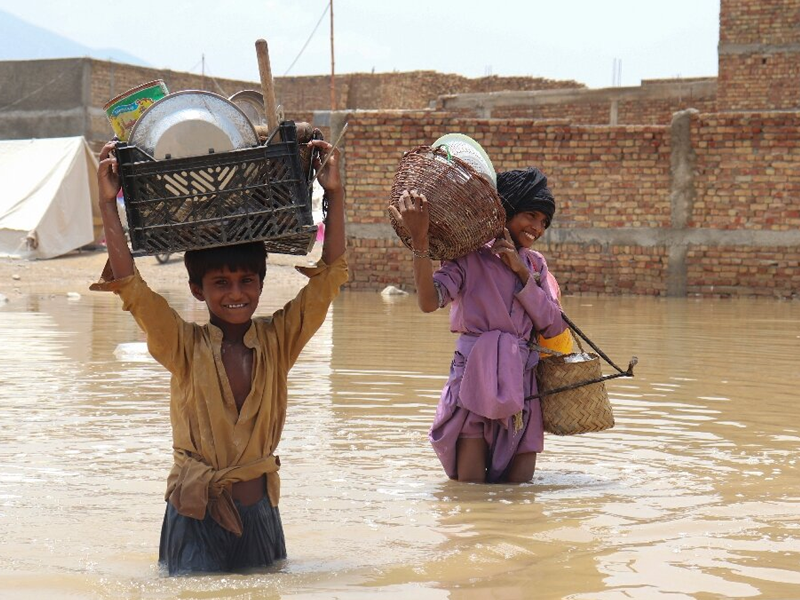
Flood is one of most dangerous natural disasters. It happens when excessive water is collected in any area. It usually happens due to heavy rainfall. Periodic floods occur on many rivers, forming a surrounding region known as flood plain.
During times of rain or snow, some of water is retained in ponds or soil, some is absorbed by grass and vegetation, some evaporates and rest travels over land as surface runoff. Floods occur when ponds, lakes, riverbeds, soil and vegetation cannot absorb all water. Water then runs off land in quantities that cannot be carried within stream channels or retained in natural ponds, lakes and man-made reservoirs. About 30 percent of all precipitation is in form of runoff small and that amount might be increased by water from melting snow.
River flooding is often caused by heavy rain, sometimes increased by melting snow. A flood that rises rapidly, with little or no advance warning, is called a flash flood. Flash floods usually result from intense rainfall over a relatively small area, or if area was already saturated from previous precipitation. Listed below are different kinds of floods: * River floods occur when water in a river overflows. This usually takes place after winter or after spring rains or as a result of snowmelt. Water gets poured into a large stream from its draining basin.
* Flash floods are caused when an extraordinarily heavy injection of water makes a river overflow its banks continuously for a period of many hours. Water injection may take form of cloudbursts, torrential rains, thunderstorms, spring thaws, ice jams, dam bursts, or spillover of drainage basins. Huge amount of water gets directed into a small drainage basin.
* Topography, state of soil {low permeability or heavy saturation}, anchor convections and impervious ground surfaces also contribute on a lesser scale. Such floods are overwhelming, involving swirling waters that reach heights of 20 feet or more with hardly any warning.
They are so powerful that they uproot trees, unearth boulders, demolish buildings, tear down bridges, and create new channels of water
* Ocean floods are caused when powerful offshore winds force water from an ocean on to land. Low barometric pressure in such winds makes ocean level rise above coastal lowlands, leading to production of storm surges. Increase in rainfall in such coastal areas (which usually are barrier islands, swamps, or plains having several rivers flowing through them) exacerbates flooding in adjoining low lying areas. Overflowing ocean water next races to mouths of river channels and inundates area with water.
* Volcanic eruption-resulting floods are caused by two factors, both associated with volcanic eruptions, melting of snow/ice and heavy rains. Such floods take place suddenly and can be massive. Iceland and Ecuador have experienced several melt-water floods brought on by volcanic heating.
* Urban floods occur in areas where rain-absorbing land is transformed from fields and woodlands into roads and parking areas. Such urbanisation renders land incapable of absorbing rainfall, resulting in runoff 2 to 6 times more than what would take place in natural terrain. Urban flooding transforms streets into fast-moving bodies of water while building basements become death-traps as they rapidly fill with water.
Reasons of floods:
* Flooding may be caused by many factors such as intense rainfall, strong winds over water, unusual high tides, tsunamis or failure of dams, elevation of retention pond levels or other structures that contain water.
Periodic flooding occurs in many rivers, forming a surrounding region known as an alluvial plain. During periods of rain or snow, some of water is retained in ponds or soil, others are absorbed by grass and vegetation, some evaporate and rest travels over land as surface runoff.
* Flooding occurs when lakes, riverbeds, soil and vegetation cannot absorb all water. Water then escapes from land in quantities that cannot be transported into channels of streams or retained in natural ponds, lakes and man-made reservoirs. About 30 percent of all rainfall is in form of small runoff and that amount can be increased by water of melted snow where it exists. River flooding is usually caused by heavy rains, sometimes increased by snow melting. Rapid flooding, with little or no advance warning, is called a sudden flood. Sudden floods usually result from heavy rains in a relatively small area, or if area was already saturated with previous precipitation.
* Severe winds over water are another cause of flooding. Even when rain is relatively light, banks of lakes and bays can be flooded as a result of strong winds such as during hurricanes that blow water to coastal areas. Another cause is unusual high tides that occur, sometimes in coastal areas when they are flooded by unusually high tides, especially when composed of strong winds and storms. Flood control and management:
* Floods can be prevented or significantly moderated by watershed management of catchments area of rivers. For international rivers originating in Nepal and Bhutan, a joint mechanism for watershed management needs to be evolved. Another way is to preserve and augment flood cushions like natural swamps and lakes which can be developed into detention basins. Also, capacity of existing depression can be improved for absorbing flood waters.
* Besides construction at appropriate location of spilling sections/’sluices’ in flood embankment areas, integration of drainage sluices with other infrastructural developmental programmes in sectors of road, railways, inland waterways and canal/command area development works are necessary for flood management. Drainage improvement in critical areas in country should be given priority.
* Development of digital elevation model of flood prone areas for taking up schemes for inundation forecast, preparation of flood risk maps, planning of flood management schemes, etc. should be taken up. * More importance should be given to non-structural actions such as flood plain zoning and flood proofing for minimising losses and to bring down recurrent expenditure on flood relief, flood forecasting and warning etc.
* In order to minimise loss of life and property in event of floods, there has to be stringent regulation of settlements as well as economic activity in flood plain zones. Flood proofing should also be done to lessen loss of life and damage to property.
Published in The Daily National Courier, September, 02 2022
Like Business on Facebook, follow @DailyNCourier on Twitter to stay informed and join in the conversation.